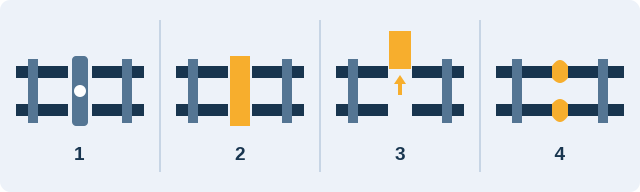
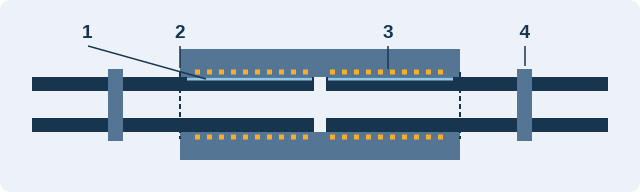
Use butt fusion for a long run when the crew has room to move the pipe and set up a machine. For a repair between fixed ends or work in a tight trench, an electrofusion coupling can be easier to fit.
How Each Joint Is Made
Butt Fusion
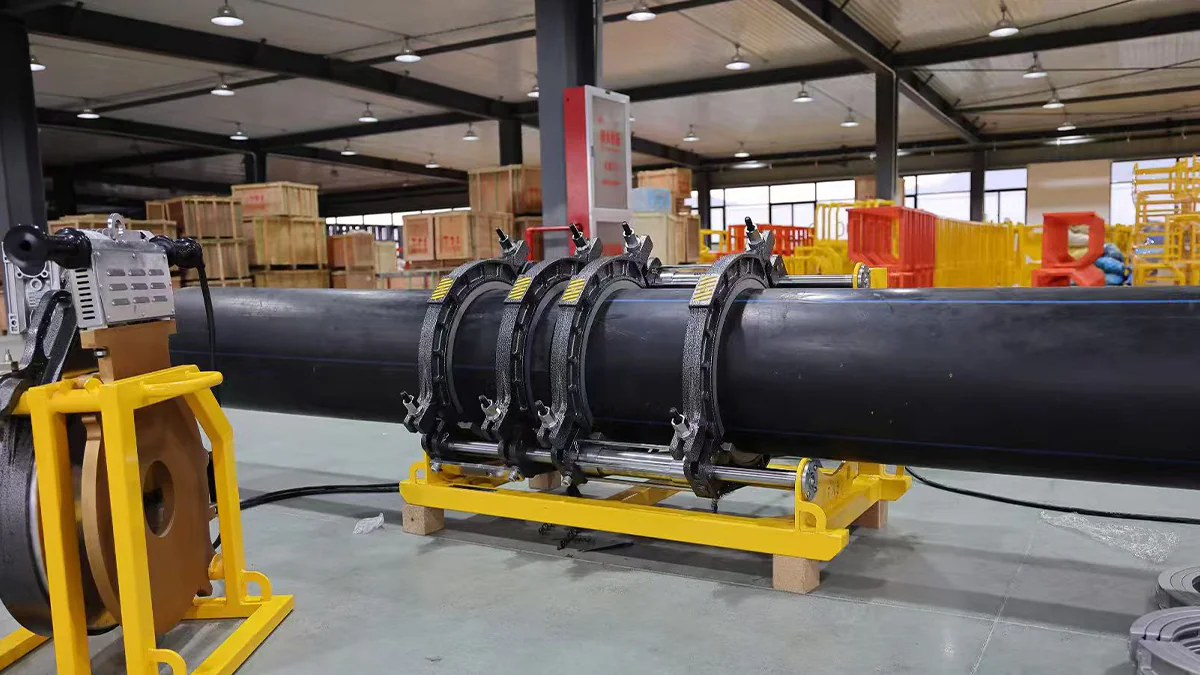
A hot plate softens the ends. The machine pushes them together and holds them still under pressure as the joint cools.
Line up the ends. Support and clamp the pipe, then trim the ends flat with the facer.
Heat both ends. Follow the approved plate temperature, pressure and heating times.
Remove the plate. Bring the ends together within the allowed changeover time.
Let the joint cool. Hold it under the specified pressure until the cooling time is up, then check the joint.
Electrofusion
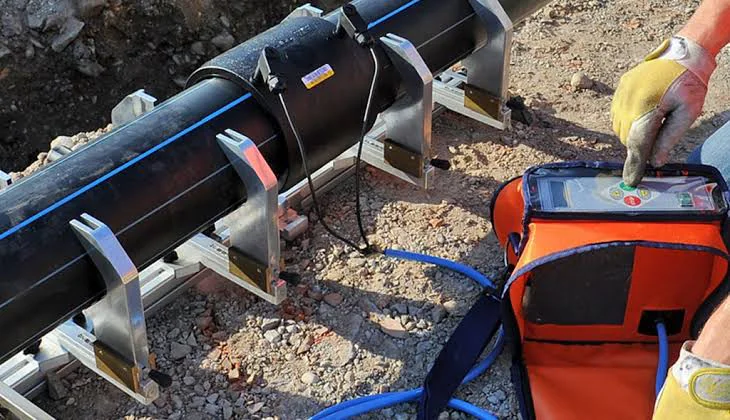
The controller heats a coil built into the fitting. The inside of the fitting and the outside of the pipe soften and join. That takes less movement at the pipe ends.
Mark and scrape the pipe. Mark how far it goes in and peel the area specified by the fitting maker.
Push to the mark and clamp. Round out the pipe if the procedure calls for it, then hold it in line.
Run the fitting’s cycle. Use a compatible controller and the cycle shown on the fitting label or barcode.
Keep the joint still as it cools. Follow the fitting maker’s times for removing the clamps and pressure testing.
A hot plate softens the pipe ends. The machine presses the ends together.
A built-in coil heats the fitting so it joins to the outside of the pipe.
What the operator sets
Use the approved heat and pressure settings. The gauge setting depends on the machine and the force needed to move the pipe.
Use a controller that can run the cycle shown on the fitting label or barcode.
Time on the machine
Thicker pipe can need more heating and cooling time.
Allow time to scrape, place and clamp the joint as well as run the cycle and let it cool.
Pipe and fitting sizes
Check the outside diameters and walls at both ends, especially where SDR changes.
The socket must fit the pipe OD and accept the SDR at both ends.
Room to work
Leave room for the machine, tools, rollers and pipe movement.
The pipe ends usually move less. Leave room to scrape and clamp around the pipe.
What you pay for
Moving the machine and pipe takes time. A straight pipe-to-pipe joint uses no separate coupling.
Each socket adds a fitting. On a tight repair, it can save excavation or cut shutdown time.
Where to use it
Long tailings or dewatering runs, or long sections made up before installation.
Repairs between fixed ends, tight trenches and selected branches.
How Long Will Each Joint Take?
Use the table to plan the work. For example, at 200 mm metric OD, the SDR 11 butt-fusion example allows 17 minutes of cooling in the machine. Also budget time to move, align and prepare each length.
What these times cover. The butt-fusion example uses the ISO 21307 single low-pressure method, a heater plate at 225°C ±10°C and cooling at 23°C ±2°C, rounded up to whole minutes. The heater removal limits and electrofusion times are equipment and fitting examples. Set the machine using the approved procedure and the actual fitting instructions.
Nominal OD (mm)
SDR / wall (mm)
Min. bead (mm)
Heat soak (s)
Example heater removal limit (s)
In-machine cooling (min)
Example electrofusion time (s)
Example electrofusion cooling (min)
Where it fits
110
SDR 11 / 10.0
1.5
120–150
≤8
13
100
10
Either method where the pipe and fittings are compatible.
SDR 17 / 6.6
1.16
80–99
≤6
10
200
SDR 11 / 18.2
2.32
219–273
≤10
17
360
15
Butt fusion for runs. Consider electrofusion at fixed tie-ins.
SDR 17 / 11.9
1.69
143–179
≤8
15
315
SDR 11 / 28.6
3.36
344–429
≤16
19
900
30
Stage a hydraulic carriage for runs and verify controller output for tie-ins.
SDR 17 / 18.7
2.37
225–281
≤10
17
450
SDR 11 / 40.9
4.59
491–614
≤20
26
1,380 × 2
30 × 2
Prefabricate pipe strings where access permits. Review flanges or a specified coupler at tie-ins.
SDR 17 / 26.7
3.17
321–401
≤16
19
630
SDR 11 / 57.2
6.22
687–858
≤25
43
1,380 × 2
45 × 2
Allow for a heavy carriage and rollers. Confirm availability and site requirements for large couplers.
SDR 17 / 37.4
4.24
449–561
≤20
24
The sizes in this table are metric outside diameters. If you are working with IPS, look up the actual diameter before ordering fittings or inserts.
Match inserts and sockets to the actual outside diameter. Check the wall size and material where the new pipe meets the old line. Look up metric and IPS dimensions.
Tools for butt fusion
Plan for the machine, inserts, facer, heater, rollers and shelter. Add a data logger if the job needs weld records. See fusion machines and butt fusion fittings.
Tools for electrofusion
Match the controller and leads to the fitting. Include a scraper, approved cleaning materials, marker and clamps. Add a re-rounding tool if needed. See fittings and controllers.
Send your pipe sizes and tell us where the crew will make the joints. Puhui can price the pipe, fittings, inserts and equipment together so the pieces arrive ready to match.