

HDPE TECHNICAL GUIDES
HDPE Pipe SDR, DR, and Pressure Ratings Explained
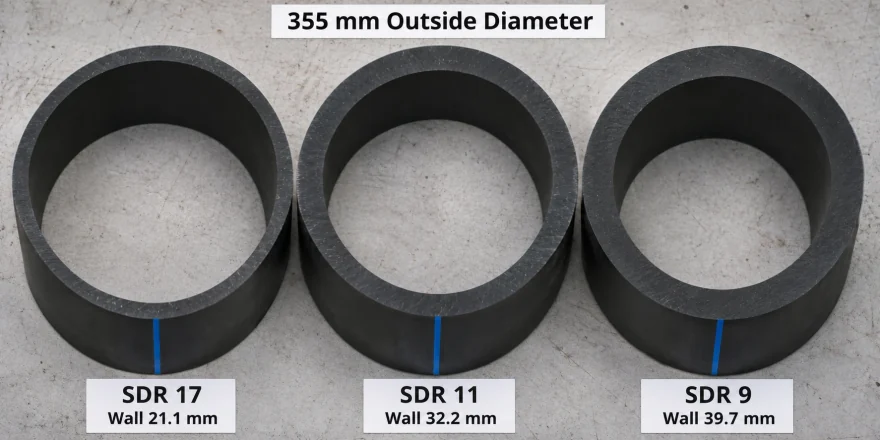
Choosing the right HDPE pipe comes down to balancing wall thickness, pressure capacity, and internal flow space. At the same outside diameter, a lower SDR number means a thicker pipe wall—which handles higher pressure and abrasion, but leaves a smaller inside opening for water or slurry to flow through.
What Do SDR and DR Actually Mean?
SDR (Standard Dimension Ratio) and DR (Dimension Ratio) use the exact same math: Outside Diameter ÷ Minimum Wall Thickness. For example, a 200 mm pipe with an 18.2 mm wall has an SDR of 11 (200 ÷ 18.2 ≈ 11).
Remember one golden rule: The smaller the number, the thicker the wall and the higher the pressure rating. The only difference between the two terms is standardization—SDR refers to internationally standardized ratios (like 9, 11, 13.5, 17, and 21), while DR covers all ratios, including specialized non-standard thickness steps (like DR 7, DR 7.3, or DR 15.5) often requested in heavy mining specs.
Quick Reference Chart: SDR, Pressure Ratings & Typical Uses
Because the ratio stays proportional across every pipe size, all pipes sharing the same SDR carry the same nominal pressure rating at standard room temperature:
| SDR / DR | Wall Thickness Profile | PE100 Pressure @ 20°C | PE4710 Pressure @ 73°F (23°C) | Common Mining & Industrial Uses |
|---|---|---|---|---|
| DR 7 | Extra-heavy wall | PN 25 (25 bar / 2.5 MPa) | 333 psi | High-pressure pump discharge & severe-wear tailings |
| SDR 9 | Very thick wall | PN 20 (20 bar / 2.0 MPa) | 250 psi | High-pressure water mains, deep pit dewatering & HDD pulls |
| SDR 11 | Thick wall (Most popular) | PN 16 (16 bar / 1.6 MPa) | 200 psi | Standard mining slurry lines, process water & plant headers |
| SDR 13.5 | Medium-thick wall | PN 12.5 (12.5 bar / 1.25 MPa) | 160 psi | Medium-pressure water transfer & heap leach distribution |
| SDR 17 | Standard wall | PN 10 (10 bar / 1.0 MPa) | 125 psi | Reclaim water return lines, pond transfer & low-pressure lines |
| SDR 21 / 26 | Thin wall | PN 8 / PN 6 | 100 psi / 80 psi | Gravity drainage, stormwater runoff & low-pressure overflow |
How Thicker Walls Shrink the Inside Bore (200 mm Example)
HDPE pipe is controlled by its outside diameter (OD) so that fittings and fusion machines always fit. When you step down to a thicker wall for higher pressure, that extra plastic grows inward—shrinking the inside bore:
| 200 mm PE100 Pipe | Minimum Wall Thickness | Approx. Inside Bore (ID)¹ | Pressure Rating @ 20°C |
|---|---|---|---|
| SDR 11 | 18.2 mm | 163.6 mm | PN 16 (16 bar) |
| SDR 17 | 11.9 mm | 176.2 mm | PN 10 (10 bar) |
¹ Calculated from nominal 200 mm OD minus twice the minimum wall thickness. Use actual supplied tolerances for final hydraulic design.
Switching from SDR 17 to SDR 11 narrows the inside bore by 12.6 mm (cutting the open flow area by roughly 14%). If your pump keeps pushing the exact same flow rate through that narrower opening, fluid velocity and friction loss go up—which increases pumping power costs and accelerates slurry wear. Always re-check your pump curve before thickening the pipe wall.
Three Real-World Factors That Change Your SDR Choice
Never pick an SDR based solely on steady room-temperature water pressure. Always check these three field conditions first:
Hot Fluids or Sun-Exposed Lines (Temperature Derating): Standard pressure ratings only apply at 20°C (68°F) for PE100 or 23°C (73°F) for PE4710. If your pipe carries warm process water or lies exposed under harsh desert sun where wall temperatures reach 38°C (100°F), its pressure capacity drops by roughly 20%. At 60°C (140°F), capacity drops by 50%—meaning you must step down to a thicker SDR to stay safe.
Pump Start-Ups, Water Hammer & Slurry Wear: Rapid valve closures or pump trips create sudden pressure spikes (surge). While HDPE absorbs surge much better than rigid steel or PVC, heavy mining lines also suffer internal sand abrasion. Engineers routinely choose SDR 11 or DR 9 on slurry lines not just for pressure, but to leave extra sacrificial wall thickness for wear life.
Never Butt-Fuse Different SDRs Together: Even though a 200 mm SDR 11 pipe and a 200 mm SDR 17 pipe have the exact same outside diameter, you cannot butt-fuse them directly to each other. Their different wall thicknesses prevent proper melt alignment, creating a weak joint. Use an electrofusion coupler or a machined transition fitting if two different SDRs must meet.
Why Do PE100 and PE4710 List Different Pressures for SDR 11?
Buyers often notice that a 200 mm PE100 SDR 11 pipe is rated at PN 16 (16 bar / ~232 psi), whereas an 8-inch IPS PE4710 DR 11 pipe is rated at 200 psi (~13.8 bar). Both use top-grade bimodal HDPE resin, so why the difference?
It comes down to the engineering standard behind the label: ISO standards (PE100) calculate pressure at 20°C using a 1.25 safety factor, while North American ASTM/AWWA standards (PE4710) calculate pressure at 23°C (73°F) using a stricter 0.63 design factor (equivalent to a ~1.6 safety factor). Compare your entire pipeline under one consistent standard—see our PE100 vs. PE4710 Guide and Metric vs. IPS Sizing Chart for full details.
How Puhui Helps You Size and Quote the Right Pipe
Puhui manufactures HDPE pipes and matching fittings across both Metric (ISO 4427 / PE100) and IPS (ASTM F714 / PE4710) standards in all major SDR/DR classes. Before you place an order, send our engineering team:
- Pipe size & standard (e.g., 200 mm Metric or 8" IPS)
- Normal working pressure & peak surge pressure
- Fluid type & maximum operating temperature (water, slurry, or tailings)
- Total pipeline length & connection type (butt fusion, electrofusion, or flanged spools)
We will confirm the exact minimum wall thickness, inside bore, and matching fittings—and send a complete, itemized package quote.
Request a Fomal Quotation Now