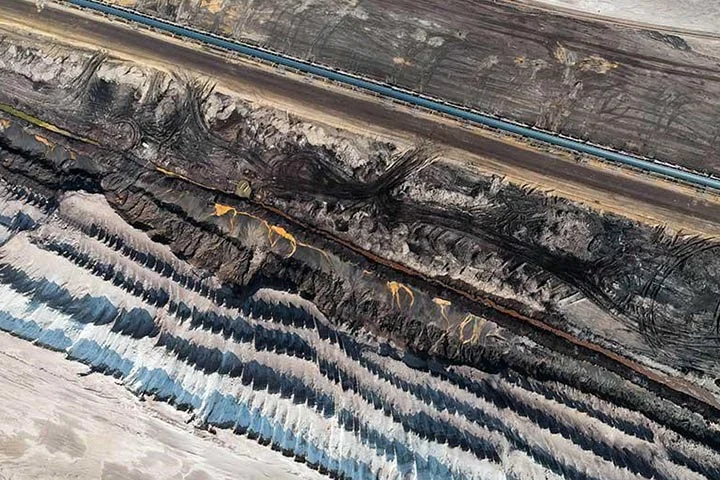
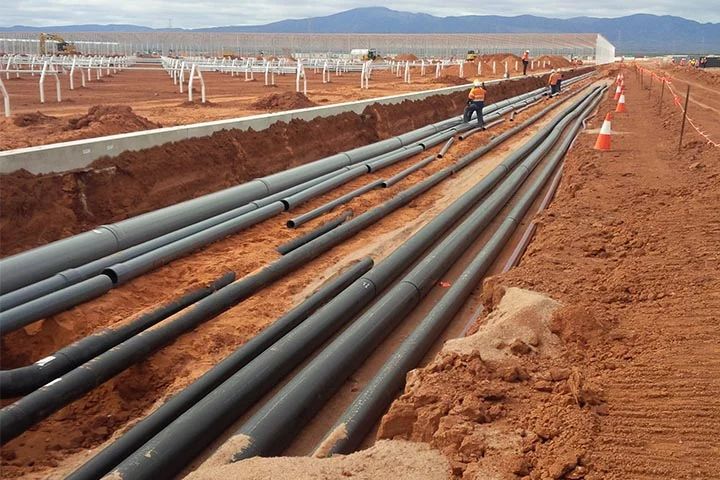
Run tailings from the thickener to storage and extend deposition lines as the facility grows. Pair a fused HDPE main with accessible branches and replaceable discharge fittings.
A tailings line can start at a thickener, cross a long elevation profile and finish in spigots that are moved as deposition progresses. Split the main, distribution branches and removable discharge lengths on the pipe schedule.
Copper, iron ore, gold and coal tailings vary in grind, solids content and chemistry. Use the plant’s normal and upset operating ranges to size each part of the line.
Separate pump discharge, crossings and low points by chainage and pressure. Keep the internal bore in the hydraulic schedule when wall thickness changes.
Provide spigot positions and orientation, blind ends and the planned order of future connections. Keep removable sections reachable as the deposition area changes.
Reclaim water has its own solids profile, suction conditions and route. Use a separate pressure and fitting schedule for the return circuit.
Conventional slurry and thickened tailings
Thickener underflow can vary over a shift. As solids rise, the pressure needed to restart and clear the line can change. For paste or highly thickened tailings, use measured rheology and distinguish the transport line from a cemented backfill circuit.
Deposition and future extensions
Separate fixed mains from sections that crews will move or replace. Include connection details for branches, transitions and removable spigots. Specify how each section drains or flushes when isolated.
Installation, operation & site conditions
Build and commission in sections
Use the route profile to set test sections and safe drain points. Retain the chainage, fusion record and component traceability for each installed section. Record deviations at crossings, supports and deposition branches in the as-built drawings.
Plan changes to the storage facility
Allow for access to isolation valves and spigots as the facility develops. Identify where a spill or flush would flow and coordinate monitoring and response arrangements with the facility’s operating plan.
Design example
Pressure zoning on a copper mine tailings line
Consider a 630 mm OD PE100-RC tailings line with separate pressure zones for the pump discharge, downhill transition and exposed run. Set the wall class for each zone from its operating and transient pressures, then check the bores and joining details at each SDR transition.
What Puhui supplies and what to send
Supply package and quotation
Puhui quotes straight pipe, fabricated tees, bends, flange kits and fusion equipment against the chainage schedule. Submit the solids range, route profile, design pressure by section, maximum restart conditions, deposition drawing and shipping lengths.
Submit the finished-pipe standard, material and pressure basis, bend and branch drawings, batch reports and inspection plan. The facility owner’s tailings management requirements govern the installed system. The pipe submittal supports that record with traceable materials and as-built joint documentation.
How does thickened tailings service affect the pipe order?
Use measured rheology and the restart pressure to choose the bore and wall class. Break out high-wear bends and removable discharge pieces in the bill of quantities.
Can the tailings and reclaim mains use one schedule?
List them as separate duties. Use each stream’s chemistry, solids loading and operating pressures to specify its pipe and joints.